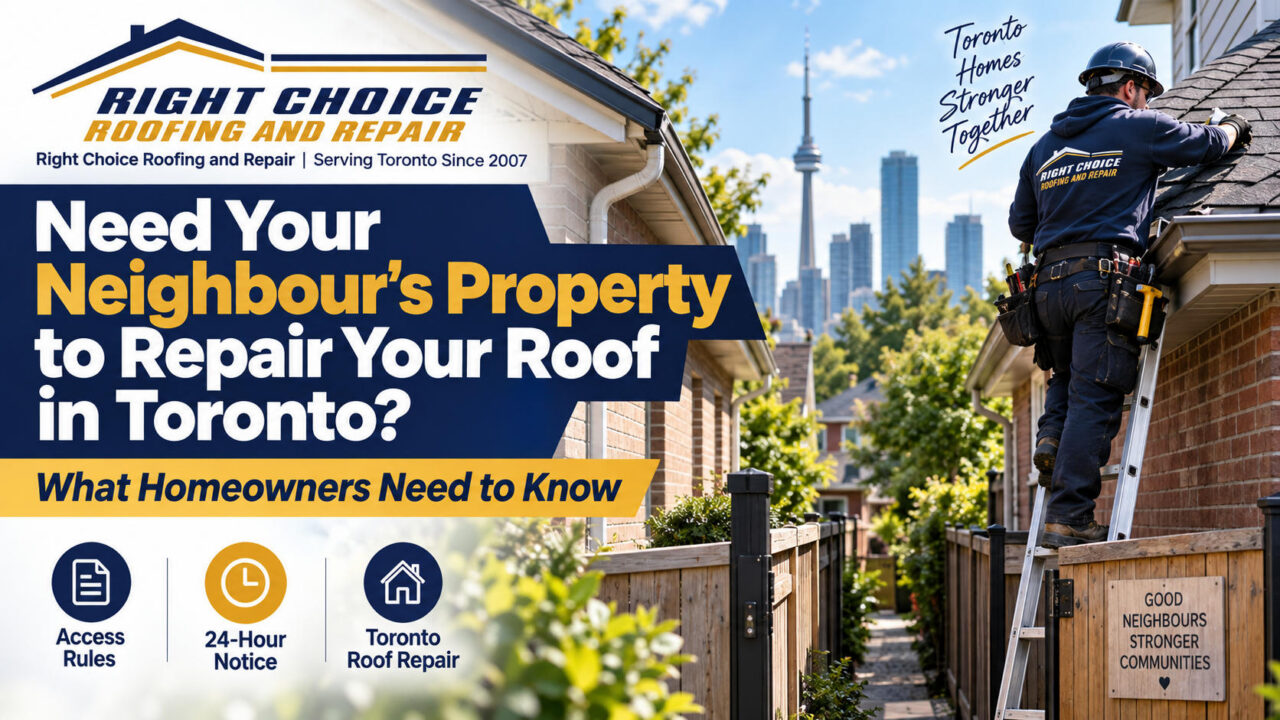
Need Your Neighbour’s Property to Repair Your Roof in Toronto? What Homeowners Need to Know
Why Difficult Roof Access Can Change the Scope and Cost of a Repair
By Frank Gillis | Owner, Right Choice Roofing and Repair | Serving Toronto Since 2007
If you own a semi-detached house, rowhouse, century home or property on a narrow Toronto lot, repairing a Roof is not always as simple as putting up a Ladder.
Side yards can be extremely tight. Air Conditioning units, Gardens, fences, Copper Drainage systems, Snow Guards, additions and neighbouring buildings can make direct Roof access difficult — or sometimes impossible.
In certain situations, the safest practical way to complete a Roof Repair may require temporary access to your neighbour’s property. Toronto has specific rules for exactly this situation.
Toronto’s Right-of-Entry Rules Explained
As of March 1, 2023, Toronto homeowners no longer require the former municipal right-of-entry permit to access neighbouring land for qualifying repairs or alterations.
That does not give a homeowner or contractor unrestricted use of a neighbour’s property. According to the City of Toronto, neighbouring land can be entered when:
- the repair or alteration cannot be completed from your own property or from a street; and
- the neighbouring land is being entered only to complete that work.
The City’s complete requirements can be reviewed here: City of Toronto — Right to Enter Neighbour’s Land for Repairs.
The authority for Toronto’s rules is also found in section 101 of the City of Toronto Act, 2006: Ontario — City of Toronto Act, 2006, Section 101.
Important: This article provides general information for Toronto property owners. It is not legal advice.
How Much Notice Do You Have to Give Your Neighbour?
For standard work, the City generally requires at least 24 hours’ written notice before entering neighbouring land. The written notice must include:
- a description of the work;
- the date the property will be entered;
- the expected duration of the work; and
- a telephone number.
The City states that notice must be provided personally or by registered mail. If the scope or duration changes, another notice must be provided.
What About an Emergency?
In an emergency, written notice may be given with less than 24 hours’ notice, or as soon as practical after the work begins.
What Can — and Can’t — Be Done on the Neighbour’s Property?
This is where the rule is commonly misunderstood. The right of entry allows qualifying access to the neighbouring land. It does not turn your neighbour’s property into a general construction area.
The City permits qualifying entry to:
- access neighbouring land when the repair cannot be completed from your own property or the street;
- perform the specific repair or alteration described in the written notice; and
- allow an employee or agent, such as the Contractor performing the work, to exercise the qualifying access.
Proper identification must be produced if requested.
The City’s rules do not authorize you or your contractor to:
- enter the neighbour’s building;
- climb onto the neighbour’s building or Roof;
- store materials or equipment on the neighbour’s land;
- park vehicles on the neighbour’s property; or
- perform work other than the repair described in the notice.
That distinction is extremely important for Roofing. Being entitled to temporarily access a side yard to reach your property does not automatically mean a Contractor can erect any type of Scaffold there, leave Roofing materials behind, or use the neighbour’s Roof as an access platform.
Any access arrangement outside the City’s stated right-of-entry provisions should be established before work begins.
Who Is Responsible If the Neighbour’s Property Is Damaged?
The City’s requirements state that the work must not create a hazard on the neighbouring land. The property must also be restored to its original condition, and compensation must be provided for damage caused by the entry or work.
For Roofing jobs, this can involve:
- Gardens and landscaping;
- walkways;
- fences;
- Air Conditioning equipment;
- Drainage systems; and
- other exterior property located in the access area.
This is why access should be part of the Roofing assessment — not something figured out after the crew arrives.
Why Toronto Roof Access Can Become Complicated
After working on Toronto Roofs since 2007, I regularly see properties where the accessibility of the repair becomes almost as important as the Roofing issue itself. Common obstructions and access complications include:
- narrow side yards;
- semi-detached and attached homes;
- three-storey houses;
- rear additions;
- Slate Roofs;
- steep Roofing systems;
- adjoining Flat Roofs;
- Roof Decks;
- Dormers;
- Parapet Walls;
- Copper Eavestroughs and Drainage systems;
- Snow Guards;
- Gardens;
- Air Conditioning units; and
- neighbouring structures extremely close to the property line.
The failed Roofing component may be small. Safely reaching it may not be.
Learn more about our Toronto Roof Repair Services.
Why Slate Roof Repairs Can Require Specialized Access
Toronto’s older Slate Roofs are a good example. A slipped, cracked or missing Slate Tile may occupy a relatively small area of the Roof. But reaching it without damaging surrounding Slate can require significant planning.
Unnecessary foot traffic across older Slate can damage otherwise serviceable Tiles. Depending on the Roof configuration, safe access may require:
- specialized Ladder positioning;
- Roof Jacks and planks;
- temporary work platforms;
- Bridgework; or
- other specialized access methods.
Snow Guards, Valleys, Copper Drainage systems, Dormers, Gardens and neighbouring structures can further limit access.
Learn more about our Toronto Slate Roofing Services.
Semi-Detached and Flat Roofs Create Different Access Problems
Toronto’s semi-detached and attached homes can create another complication. Two Roofing systems may appear connected even though they belong to separate properties. Problem areas can occur around:
- Parapet Walls;
- dividing walls;
- Roof Decks;
- adjoining additions;
- counter-Flashing systems;
- drainage areas; and
- property-line transitions.
Before deciding how a repair should be completed, both the Roofing problem and the available access need to be assessed.
Learn more about our Toronto Flat Roof Repair Services.
Neighbouring Property and City Property Follow Different Rules
This is one of the most important distinctions in this article. Accessing neighbouring private property and occupying City of Toronto property are two separate issues.
If Roofing equipment or materials need to occupy an area beyond the private property line — including a sidewalk, boulevard, roadway or public laneway — a Street Occupation Permit may be required. The City specifically lists equipment and activities including:
- scaffolding;
- walk-through or staging Scaffold;
- covered walkways;
- Lifts and Cherry Pickers;
- Mobile Cranes and Boom Trucks;
- Roof Hoists;
- Swing Stages;
- Rope and Tackle;
- Ladders;
- Disposal Bins; and
- storage of equipment or materials.
Toronto’s current requirements are available here: City of Toronto — Street Occupation Permit.
The City currently states that a Street Occupation Permit is required before beginning a project where the public right-of-way will be temporarily occupied.
Why a Small Roof Repair Can Still Require Extensive Access
A small damaged area does not necessarily mean a simple repair. For example, replacing several damaged Slate Tiles or repairing a localized Flashing issue may be relatively straightforward once the repair area can be safely reached. Getting there may require:
- temporary work platforms;
- Roof Jacks and planks;
- Scaffolding;
- Bridgework;
- specialized Ladder access;
- temporary removal of Drainage components;
- protection of surrounding Slate;
- protection of Gardens and landscaping;
- working around Air Conditioning equipment; or
- coordination involving neighbouring property.
The access method has to match the property, the Roofing system and the location of the repair.
A Drone Can Find the Damage — But It Cannot Solve the Access Problem
Drone inspections are extremely useful on difficult Toronto Roofs. They can identify visible problems such as:
- missing Slate;
- damaged Shingles;
- deteriorating Flashing;
- Chimney problems;
- Parapet deterioration; and
- other visible Roofing failures.
Learn more about our Toronto Aerial Drone Roof Inspections.
But seeing a problem from the air does not establish how a Roofer will physically reach it. Some Roofing conditions can also only be confirmed through hands-on inspection. A proper assessment should therefore answer two different questions:
What appears to be wrong?
How can it be safely accessed to confirm and repair it?
For complicated Roofing situations, learn more about our Toronto Roof Consultation Services.
10 Questions to Ask Before Approving a Difficult-Access Roof Repair
Before work begins, ask your Roofing Contractor:
- How will the damaged area be safely accessed?
- Will neighbouring property be required?
- Will equipment occupy a City sidewalk, boulevard, roadway or public lane?
- Will Scaffolding or specialized access equipment be required?
- Are Gardens, landscaping or Air Conditioning units in the access area?
- Will Eavestroughs, Copper Drainage systems, Snow Guards or other Roofing components need to be temporarily removed?
- Is the cost of the required access system included in the quote?
- Are there Roofing or structural conditions that cannot be confirmed until physical access is established?
- How will neighbouring property be protected?
- Who is responsible for making sure the required written notice and permits are handled before work begins?
What If Your Neighbour Objects?
Start with clear communication. Explain:
- what is being repaired;
- why access is necessary;
- when the work is expected to happen; and
- approximately how long it should take.
Where Toronto’s right-of-entry provisions apply, make sure the City’s written-notice requirements are followed properly. If neighbours cannot resolve the issue themselves, the City identifies community mediation as a possible option.
Serious disputes over property rights, access or liability should be dealt with through appropriate legal advice rather than expecting a Roofing Contractor to resolve a legal disagreement.
Good Roofing Starts Before Anyone Climbs the Ladder
A proper Roof Repair is not simply about replacing whatever material appears damaged. A Roofing Contractor may also need to determine:
- what failed;
- why it failed;
- whether surrounding problems exist;
- what remains unconfirmed;
- how the repair area can safely be reached;
- whether neighbouring or City property will be affected; and
- what equipment is required to complete the repair properly.
On many Toronto homes, access is part of the Roofing problem itself.
Right Choice Roofing and Repair has been providing Residential and Commercial Roofing services throughout Toronto since 2007. If you have a difficult-to-access Roofing problem, I can assess both the Roofing issue and what will actually be required to safely reach and repair it.
Right Choice Roofing and Repair — Toronto’s Trusted Local Roofer Since 2007.
Frequently Asked Questions
Can my roofer legally enter my neighbour’s yard to repair my roof in Toronto?
Potentially. Toronto allows qualifying access to neighbouring land when repairs or alterations to your property cannot be completed from your own property or from a street, provided the City’s conditions are followed. This is a limited right and does not authorize unrestricted use of the neighbouring property.
How much notice must I give my neighbour?
The City generally requires at least 24 hours’ written notice. It must describe the work and provide the date of entry, expected duration and a telephone number. Emergency situations are treated differently.
Can my roofer store materials or equipment in my neighbour’s yard?
Not under the City’s right-of-entry provision alone. Toronto specifically states that the provision does not authorize storage of materials or equipment, or parking vehicles, on the neighbouring land.
What if roofing equipment needs to be placed on a Toronto sidewalk or roadway?
A Street Occupation Permit may be required. Toronto specifically identifies scaffolding, Roof Hoists, Ladders, Lifts, Boom Trucks, Disposal Bins and other construction equipment or materials occupying the public right-of-way.
Why can a small roofing repair cost more because of access?
Because the size of the damaged area and the difficulty of reaching it are separate issues. A small repair may still require Scaffolding, specialized Ladder access, work platforms, Bridgework, protection of existing Roofing components, or coordination involving neighbouring property.
Roof Repair in Toronto? We'll Fix It Right — Guaranteed.
From missing Shingles and active leaks to Flat Roof repairs and Slate Roof restoration, Right Choice Roofing and Repair has been fixing roofs across Toronto since 2007. We show up on time, use quality materials, and back every repair with a 2-year workmanship warranty. Don’t wait until a small problem turns into a costly replacement — call us today and let’s get your roof sorted out fast.
We Service the Greater Toronto Area and include
- York, Ontario
- High park, Ontario
- Roncesvalles, Ontario
- Bloor West Village, Ontario
- The Junction, Ontario
- Parkdale, Ontario
- Mimico, Ontario
- Yorkville, Ontario
- Rosedale, Ontario
- Forest Hill, Ontario
- Summerhill, Ontario
- Davisville Village, Ontario
- Willowdale, Ontario
- Newtonbrook, Toronto
- Don Mills, Toronto
- Bayview Village, Toronto
- Downsview, Toronto
- York University Heights, Toronto
- The Bridle Path, Toronto
- Leaside, Toronto
- East York, Toronto
- Todmorden Village, Toronto
- Pape Village, Toronto
- Woodbine Heights, Toronto